

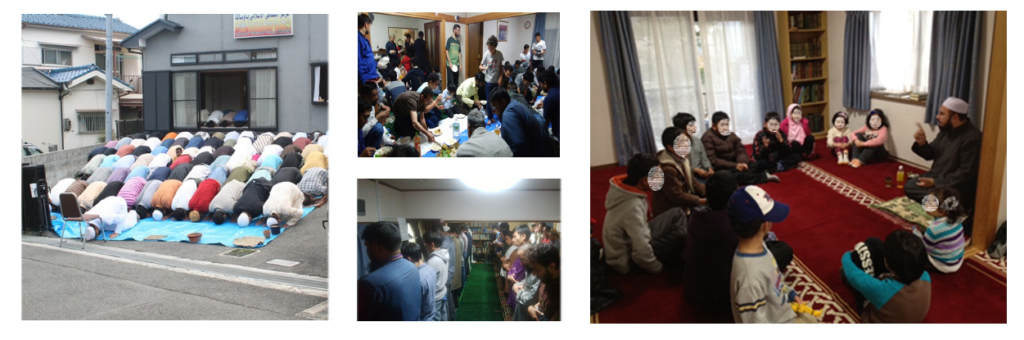

4-6-13, Toyokawa, Ibaraki City , Osaka , Japan. Tel/Fax: 0726-43-7420

Imam Mohsen

.
Seeking Advice
These days it is possible to seek answers to all our questions on the internet, and have them answered by the most learned Islamic scholars. Moreover, when a renown scholar from a well-known Islamic establishment visits Japan, it is only natural to ask him for his advice. However, such learned scholars might refrain from making a ruling by explaining that they are not qualified to pronounce an appropriate Islamic Judgement without a deeper knowledge and experience of the life of Muslims living as a minority here in Japan.
Muslims living in this country are in a unique situation, and a broad, practical understanding of the difficulties they face, the lack of a nearby mosques, of Muslim neighbors, and halal supplies, the prevailing local customs and beliefs to name but a few, are necessary to make a correct ruling.
If any brothers and sisters have a question about their religion in general or about Muslim life in Japan in particular, they are most welcome to contact Imam Mohsen for advice.
Imam's Advice
| Assalamu alaikum wr wb Imam Mohsen, I have question regarding Zakatul Maal How about Zakat Maal on our savings that will be used for buying our house, car, etc? Current condition: we are saving but still don't have a house and a car. Thank you Wassalamu alaikum wr wb -Abdi Pratama- Osaka, Japan The answer: Praise be to Allah. If a person owns the nisaab (minimum amount of wealth at which zakat becomes due) and one full hijri year has passed since he acquired it, then he must pay zakat on it, Regarding to the money set aside for a need like building a house or getting married and so on, The scholars has two different opinions regarding that: 1- There is no Zakat on the money saved for an original need like building a house or getting married and so on, because according to the hadeeth of the Prophet (peace and blessings of Allah be upon him) he said to Mu'aadh ibn Jabal when he sent him to Yemen: “Tell them that Allah has enjoined upon them charity from their wealth, to be taken from their rich and given to their poor.” Narrated by al-Bukhaari. Also they said zakat is obligatory on the rich, and the person saving money to build a house or get married and so on is not rich, because this money is as if it does not exist. 2-The second opinion said: If the conditions of zakat being due are met with regard to this money, such as it reaching the nisaab and one full (hijri) year having passed since it was acquired, then zakat must be paid on it, even if this money is being saved to meet a specific need such as accommodation, education or maintenance or so on, because of the general meaning of the evidence which states that paying zakat on wealth is obligatory. So there is a choice, however in my humble opinion, it better to pay Zakat on this saved money for the benefit of the poor and the needy.Some people neglect the issue of the blessing on wealth. A person may own huge amounts of wealth but it is not enough for him, and it does not bring him what he wants; he does not feel any sense of ease or happiness because of it. But someone else may own a small amount of wealth that has been blessed for him, so he is happy and content with it. This is something that is well known. And Allah knows the best. Mohsen Shaker Bayoumy Imam of Osaka Ibaraki Mosque |
1. Acting upon a weak (da'eef) hadeeth which speaks of good deeds (Fazaal A'amal)
Definition:
A weak hadeeth is a hadeeth that does not meet all the conditions of an accepted hadeeth. Accepted hadeeth are divided into levels: a sound hadeeth ( hadeeth saheeh ) which is of the highest level and a good hadeeth ( hadeeth hasan ) which is of the second level.
The scholars have differed concerning acting upon a weak hadith which speaks of good deeds ( Fazaal A'amal ).
There are three opinions:
1. A weak hadith cannot be followed in any situation. This opinion is supported by Alqazy Abu Bakr ibn al-Arabi, and also by Ibn Sayyid Annas, and Yahya bin Maeen. It was also stated by Al-Albanian.
2. A weak hadith can be followed in any situation. This opinion is attributed to Abu Dawood and Imam Ahmed, may Allah have mercy upon him, who said: “To relate a weak hadith is better for me than the words of men.”
3. It is permissible to narrate and act upon a weak hadith which is not concerned with Belief ( Aqeeda ), or halal and haram matters. This opinion is attributed to Abdul Rahman bin Mahdi, Ibn Almubarak, Ahmad ibn Hanbal, Ibn Assalaah, and An-Nawaawiy, with the stipulation that the weak hadeeth should encourage virtuous deeds and like actions. Al-Hafiz ibn Hajar stated that it is permissible to act upon a weak hadeeth which speaks of good deeds as long as it complies with the following three conditions:
1. The hadith must not be very weak. If its chain of narrators includes a liar, or one who is accused of lying, obscenity, or making a mistake, it is not permitted.
2. The hadith falls under the general rule of Saheeh and has not been ruled invented or incorrect.
3. To believe when you act upon it that it has not been proved to be true, and to have a reservation about it, so as not to attribute to the Holy Prophet, blessings and peace be upon him something that he did not utter.
4. In addition to the three conditions above, Shaykh Muhammad Saalih al-Othaimeen, may Allah have mercy on him, in his explanation of Al Manzomah Albaiqoni, stated that it is like the carrot and the stick . (It encourages good deeds)
Abstract:
It is clear from the above evidence that acting upon a weak hadeeth which speaks of good deeds is permissible according to some scholars as long as the conditions above have been met. This does not mean that it is recommended ( mustahabb ) to perform an act of worship only because it is stated in a weak hadeeth. It is the opinion of at least one of the scholars that if the virtues of a good deed have been mentioned in a sound hadith, and there is a weak hadith about the same topic, for example, standing in prayer at night, which is recommended in many sound hadith, then this good deed is permitted even though the initial reason for performing it was a weak hadith.
Therefore the meaning of acting upon a weak hadith which speaks of good deeds is to encourage people to perform supererogatory acts of worship in order to obtain the rewards mentioned in the weak hadeeth. If following what is recommended by a weak hadith does not entail anything that is prohibited or illegal according to the sunnah, but is only for the sake of a earning the reward of a good deed, there is no harm in it.
And Allah knows best.
Mohsen Shaker Bayoumy
Imam of Osaka Mosque
2. The Ruling on Combining Two Obligatory Prayers Habitually
Dear Brothers and Sisters,
Assalamu alaykum wa Rahmatu Allahi wa barakatuh
Praise be to ? Allah, and prayers and peace be upon our master Muhammad, blessings and peace be upon him, and on his family and followers in every place and time.
Joining the obligatory prayers for reasons other than travel or rain
First: Some of the hadith concerning the effects of combining two obligatory prayers for reasons other than travel or rain:
1 - Al-Bukhari and Muslim narrated that Ibn Abbas, may Allah be pleased with him reported that the Prophet, blessings and peace be upon him, prayed Zuhr and Asr together, and also Maghrib and `Ishâ' seven (rak'ahs) and eight (rak'ahs) 7 or 8 while at home in Madinah, although he was neither in a state of fear nor on a journey. (Tirmidhi & Abu Dawod & Annasay & Muslim) and that the Prophet, blessings and peace be upon him, said: "Pray Zuhr with Asr and Maghrib with Isha, no fear and no rain." In the version of this hadith in Sahih Muslim Saeed bin Jabir says: “I asked Ibn Abbas: ‘Why did he do that?' He said: ‘It was so as to remove hardship from the people'. ”
2 - Tabarani narrated a similar hadith by Ibn Masood: The Messenger of Allah, blessings and peace be upon him, combined Zuhr with Asr and Maghrib with Isha. When he was asked about that, He said, "I made this so as not to give hardship to my Ummah (nation)." The hadiths contained the words: without (the excuse of) fear and travel, and the words: without (the excuse of) fear and rain, but all three (fear, rain, and travel) are not mentioned together in any of the books of hadith. The most well-known is without (the excuse of) fear and travel.
3 - In is mentioned in Bukhari and Muslim from Ibn Abbas that the Prophet, blessings and peace be upon him, in Madinah prayed seven and eight (rak'ahs) and that Abu Ayyub al Alsikhitiyanj asked Aba Ashatha'a (Jabir bin Zaid) the narrator from Ibn Abbas: "Perhaps it was on a rainy night." He replied: “Perhaps.”
These are some hadith regarding combining the prayers, and the scholars of hadith are in two groups regarding understanding these hadith:
A) A group of imams went to the apparent meaning of the hadith of Ibn Abbas so they allowed the combining the prayers for the residents of a city, not for travelers, but for the convenience of all, provided, however, that it was not adopted as a habit. Ibn Hajar said in Fath al-Bari: Those who said this were Ibn Sirin, Rabia, Ibn Al-Monther and Al-Qaffal Alkabeer, and it is narrated by Al-Khattabi that a group of scholars of hadith said the same, and Al Shawkaani said in Nail Al-Awtaar: This interpretation is acceptable as long as there is a justifiable excuse.
B) The majority of imams forbid combining prayers without an excuse, arguing that it is a consensus, and should therefore be followed, no matter who deviated after the first consensus.
This is because the schedules of the set times of prayers that have been passed down cannot be ignored without an excuse, and because excuses such as travelling, have been taught by the Prophet, blessings and peace be upon him. It is well known that he combined two prayers when travelling and in sickness and at the time of rain. It was narrated that the Prophet, blessings and peace be upon him, said to the mustahadah (the woman whose bleeding continued after her menstruation period ended), and this is a type of sickness - "If you can pray Zuhr at the latest time and then you can pray and Asr at its first time, so you can combine the two prayers and do the same with Maghrib and Isha".
In the Muwatta of Imam Malik it is related from Nafi' that 'Abdullah ibn 'Umar used to join the prayer behind the amirs if they joined Maghrib and 'Isha' in the rain. Ibn Umar combined the prayers with them, and al Athram in his Sunan narrated that Abu Salamah ibn Abd al-Rahman said: Combine Maghrib and Isha if it is a rainy day of the year.
Explanations by prominent scholars as to the best interpretation
The majority of the Imams followed the hadith of Ibn Abbas, who reports the former combination without an excuse, and they had many explanations and perhaps the best opinion is that the combination of Zuhr with Asr, and Maghrib with Isha, which was done by the Prophet, blessings and peace be upon him, in Madinah without travel or sickness or rain, was a Shuwari combine (it just appeared to be so), meaning that he prayed Zuhr at its very latest time and then very soon after that he prayed Asr prayer at its earliest time, so that there was such a short time between them that it appeared that they were prayed together.
So it is appears as if he combined the two prayers but in fact he prayed each one within its allotted time, because he prayed at the latest time and earliest time of each prayer. He often advised his companions of the virtues of performing the prayer on time but he did it because he understood that sometimes there may be some genuine excuses to prevent one from praying at the earliest time, so the Prophet, blessings and peace be upon him, did that occasionally so as not to make undue hardship for of his nation, and to let us know that performing the prayers at the latest time does not make it Qaza (it does not need to be made up) and that there is nothing wrong in the delay as long as there is a good reason for it.
This answer was favored by Imam Ibn Hajar in His book "Al Fath" and he said: It is the choice of many Imams like Al Qortobi and Imam Al-Haramin (Al Jowiny) and Ibin Almajshon and Attahawy, and it is supported by Aba Ashatha - the narrator of the hadith from Ibn Abbas – he said the same.
Then Ibn Hajar said: The strongest opinion is that it is a shuwari (apparent) combination, because none of the hadith mentions combining without mentioning the time. Generally it is not acceptable to pray any prayer out of its time without an excuse. Therefore we have either 1) To uphold combining prayers in general means that it will be applied in any situation, which is to condone praying outside of the limited time without an excuse, and this is not acceptable, or 2) to uphold it as a special situation, as a shuwari combine which is the best interpretation.
It indicates that this combination - which was in Madinah without excuse - was shuwari, there is hadith in Annasai narrated by Ibn Abbas said: I prayed - with the Prophet of Allah, blessings and peace be upon him, Zuher with Asr together and Maghrib with Isha together, he prayed Zuher at its late time and prayed Asr at its first time, and He prayed Maghrib at its late time and prayed Isha at its first time, So Ibn Abbas the narrator of the hadith Declared that it is shuwari combination, also the hadith in Bukhari & Muslim that Amr ibn Dinar said : O Aba Ashatha, I think he prayed Zuher at its late time and prayed Asr at its first time, and he prayed Maghrib at its late time and prayed Isha at its first time, So Aba Ashatha said: I think it, Aba Ashatha is the narrator of the hadith of Ibn Abbas about the combination of prayers, and this is supported that this combination was shuwari.
The text of Imam al-Tirmidhi May Allah has mercy on him said it is not permissible to act upon this hadith, he said that (5 / 692) that all the Hadith he narrated in his book have been approved by some scholars, or mostly, except for two, which are unanimously rejected: the hadith of Ibn Abbas that the Prophet, blessings and peace be upon him, combined Zuhr and Asr in Madinah, Maghrib and Isha without travel and no rain, and the second Hadith about killing the wine-drinker in the fourth time ..
Conclusion
If the Muslim is in difficult or discomfort it is permissible for him to take the first opinion (A above) but only on the condition that it is not taken as the norm or established as a regular habit, as this is what has been stated by advocates of this view themselves.
And Allah knows best,
And we will answer the second part of the question later, in Sha'a Allah.
Your brother, Mohsen Shaker Bayoumy,
Imam of Osaka Mosque
3. Ruling for men to cover their shoulders whilst praying
Dear Brothers and Sisters,
Assalamu Alaykumu,
Praise be to ? Allah, and blessings and peace be upon his Messenger Muhammad and upon his family and companions and all who follow them in truth until the Day of Judgment.
A brother has raised a question which also highlights a contentious issue which has led to much confusion among the Muslims. That is the taking of a summary or an extract or a few words of a scholar without considering the full context or the reason why the statement was made, and then adopting this view without first taking the opinions of other scholars and considering the weight of their views and the strength of the evidence.
For example, quoting only part of a saying for Imam al-Nawawi, when he said in "Sharh Saheeh Muslim: "Ahmad and some of the salaf said: the prayer is invalid until a man puts something over his shoulder ....... “
This is completely misguiding, because if the whole context is known it will be clearly understood that Imam al-Nawawi was completely against this view, which he said was the Hanbali view. He was citing Imam Hanbal for the sake of scientific integrity only, so his words in this case might give the illusion of agreement and support of this view but this was not the case.
So I repeat again my advice to all the brothers not to talk about controversial issues without having the complete picture, in order to prevent the confusion that arises, and Allah is the Conciliator for all good and the Guide to the Straight Path.
Ruling for men to cover their shoulders whilst praying
All the Fuqaha'a agree unanimously on the necessity of covering the private parts in prayer. The Awrah of the man is between the navel and the knee, and some of scholars include the navel and the knee in the Awrah .
They differ in whether it is obligatory to cover the Ateq (between the shoulder and neck) as follows:
1-The majority of them said it is not obligatory, (and some of their evidence will come later, insha'a Allah).
2 - Hanbali scholars said it is the duty for Fard (obligatory prayers) in particular and prayer is not valid without it, and they supported their opinion by quoting the Hadeeth in al-Bukhaari (359) and Muslim (516) narrated from Abu Hurayrah (may Allah be pleased with him) who relates: The Prophet (blessings and peace be upon Him) said: “A man should not pray in a single garment with nothing on his shoulders.” Ahmad and some of the salaf said: “The prayer is invalid until the manputs something on his shoulder s,” because of the apparent meaning of the hadeeth. Imam Ahmad ibn Hanbal (may Allah have mercy with him) narrated that the man's prayer is valid, but he is sinning by not putting something on his shoulders.
The majority of Fuqaha'a supported their opinion by the hadeeth which is narrated in Bukhari (361) and Muslim (3010) from Sa'eed ibn al-Harith, who related: “We asked Jabir bin Abdullah (may Allah be pleased with him) about praying in a single garment. He said: ‘I accompanied the Holy Prophet (blessings and peace be upon him) on some of his travels, and when I came at night for something I found him in prayer, and I prayed with him. He was dressed in a single garment. When he had finished his prayer he said “ Maasory Jabir?” (Maasory: walking in the night:- meaning he was asking Jabir about why he had come at that time) I told him my need, and when he had finished he said: "What is this cloth that I see you wearing?” I said: “It is too small.” He said: “If it is largecover all of your body, but if it is narrow cover below your waist. ”
According to the majority of Fuqaha'a the saying of the Holy Prophet (blessings and peace be upon him) in the hadeeth of Jabir (may Allah be pleased with him): “If it is large cover all of your body, but if it is narrow cover below your waist,” indicates that it is permissible to pray with naked shoulders. This is because the Prophet (blessings and peace be upon him) approved Jabir ibn Abdullah (may Allah be pleased with him) praying with bare shoulders although he was wearing a narrow cloth which only covered below his waist, and only advised him to cover all of his body if he had a wider piece of cloth.
The majority of Fuqaha'a have said about the hadeeth of Abu Hurayrah (may Allah be pleased with him) invoked by the Hanbalis that it is mustahabb (recommended) and is not obligatory and that all the evidence should be combined. This is the view of Maalik, Abu Hanifa and Shafi'i (may Allah have mercy on them), where they said: this prohibition is Tanzehi (disliked) not Tahrimy (censured). If a man prays in a single garment that covers his Awrah but his shoulders are not included his prayer is valid, and also quoted that the Prophet (blessings and peace be upon him) prayed in a single garment, or one of the ends of his wife's bed cover, while she was sleeping, which is also mentioned by Ibn Hajar in al-Fath, quoting Imam Khattabi.
Conclusion:
After considering the above evidence, the Islamic ruling in this matter is that it is not obligatory for men to cover their shoulder in the prayer, but it is recommended that they should adorn themselves as well as they can out of respect for the prayer and standing before Allah be glorified and exalted. However, if a man prays with bare shoulders his prayer is valid.
And Allah knows best.
Mohsen Shaker Bayoumy
Imam of Osaka Mosque
Questions from Kanazawa Mosque 2010.11.7
1) I would like to ask about our rights and duties as a Muslim foreigners in a non-Islamic country , specially for the confirmation about Halal food because sometimes we do not confirm well about whether our food contains any Haram additives or not and we give ourselves some excuse as a foreigners in non-Islamic country,,,,,,and also about the excuses for Praying in Jamaah ( Salat El Jamaa) ….Jazakom Allah Khaira
Praise be to Allah,
Some of the rights and duties as a Muslim foreigner living in a non-Muslim country:
1. First and foremost, every Muslim should try to show the beauty of Islam to the others threough his good manners and character, so that he will be caller to Islam in a practical way.
2. A Muslim should fear Allah with regard to Halal and Haram in general and regarding food especially for himself and for his family members; he should teach and advise them sincerely and take good care of them, and protect himself and his family from the Fire of Allah.
3. Muslims must strive to establish study circles for learning Qur'aan and (Islamic) knowledge, in which the ignorant may be taught and the young Muslims may learn to obey Allah. It is not permissible for them to be careless about this important matter.
4. Try to invite scholars and seekers of knowledge to come to you , so that they can undertake the duties of calling people to Islam, exhorting, guiding and teaching. Such meetings will play a part in uniting you and helping you adhere to the rulings of sharee'ah which have to do with the realities of your lives.
5. Do not leave any room for the shaytan to cause division in your ranks and spread disunity among you. You have to be aware that you are living in a non-Muslim country.
6. Muslims should to try to pray in Jama'ah as much as they can, and they should bear in mind that Allah will help them to do so when the Niyyah is for His sake only.
7. Muslims should preserve their Islamic identity and strive to spread the message of Islam, free of distortions; they should present it to the Muslims and to the non-Muslims as well, and they should prove to the non-Muslims that our religion is a religion of unity, brotherhood and cooperation in righteousness and piety.
8. The Muslims must keep their brotherhood strong and always continue to call people to Allah
9. It should be a priority of Muslims as we said, to preserve the identity of the Muslims who are living here in Japan. One of the most important means of preserving their identity is for Muslims to strive to create an Islamic atmosphere in their social lives.
10. We advise everyone to be gentle in calling people to Allah and to follow the way of the Prophet and Messenger. Perhaps Allah will guide one person to Islam who will become very influential.
11. Muslims should always be in contact with each other, so that they can consult each other about their affairs and ask the scholars about issues and problems that they are facing. The Muslim is the mirror of his brother.
2) How much is the nisaab for zakaah (obligatory charity) with regard to paper money?
Also, tell me about eligibility for Zakaah.
Answer:
Praise be to Allah,
Nisaab ul-Zakat for naqd (gold and silver) is defined as the minimum amount of naqd specified by shari'a below which one is not required to pay zakat, whereas if one's wealth exceeds it then zakat becomes incumbent.
And it is known that zakat ul-maal (wealth) in shari'a is required for the two types of naqd—gold and silver—and what serves their function in modern times (commonly referred to as cash), whether it is dollars or yen or pounds or otherwise.
Nisaab for gold as our Prophet (peace be upon him) has informed us (and for currencies made from gold) is 20 mithqaalan, a measure which is equivalent to 85 grams of pure gold (1 mithqaal = 4.25 grams). It becomes incumbent upon anyone who owns such an amount in any form to pay zakat on it in the amount of 2.5%.
Nisaab for silver and currencies made from silver is 200 dirhams, which is equivalent to 595 grams of pure silver (1 dirham = 2.975 grams). Likewise, it becomes incumbent upon anyone who owns such an amount in any form to pay zakat on it in the amount of 2.5%.
It is well known that there is a noticeable disparity between the value of nisaab for gold and that of silver in our times. The best and most conservative for a poor person is to assess how many dollars he has that have been in his possession for a complete lunar year. If the amount reaches the value of nisaab for silver or more, then he should pay from it for every 1000 dollars, 25 dollars (i.e., 2.5%) to be spent in the prescribed manner as specified by shari'ah, Allaah, may He be exalted, says
“As-Sadaqaat (here it means Zakaah) is only for the Fuqaraa' (poor), and Al-Masaakeen (the poor) and those employed to collect (the funds); and to attract the hearts of those who have been inclined (towards Islam); and to free the captives; and for those in debt; and for Allaah's Cause (i.e. for Mujaahidoon — those fighting in a holy battle), and for the wayfarer (a traveller who is cut off from everything); a duty imposed by Allaah. And Allaah is All-Knower, All-Wise”
[al-Tawbah 9:60].
And Allah knows best.
3) Spending ZAKAT whole or part for building a Masjed, it can be consider legal or not ?
Answer:
Praise be to Allah,
AS we said in the preface question the Zakat has to spent in the prescribed as specified by shari'ah, Allaah, may He be exalted, says:
“As-Sadaqaat (here it means Zakaah) are only for the Fuqaraa' (poor), and Al-Masaakeen (the poor) and those employed to collect (the funds); and to attract the hearts of those who have been inclined (towards Islam); and to free the captives; and for those in debt; and for Allaah's Cause , and for the wayfarer (a traveler who is cut off from everything); a duty imposed by Allaah. And Allaah is All-Knower, All-Wise”
[al-Tawbah 9:60].
One of them is and for Allah's Cause, the majority of the scholars explained that “for Allah's cause (fi sabeel-Allah)” refers to jihad for the sake of Allah. Some other scholars also added Hajj to that because of a hadeeth which was narrated to that effect.
Ibn Katheer (may Allaah have mercy on him) said:
With regard to [the phrase] “for Allaah's cause (fi sabeel-Allaah)”, this includes the warriors who do not have a regular salary from the state. According to Imam Ahmad, al-Hasan and Ishaq, it also includes Hajj for the sake of Allaah, because of the hadeeth.
Tafseer Ibn Katheer, 2/367.
Some other scholars including building the Masjed in this time also “for Allah's cause (fi sabeel-Allah)” one of those scholars is Dr., Yusef Al-Quradawe.
In my humble opinion we have to think about the great aim of Jihad which is to spread Islam, So for the non-Muslim countries where the Muslims are a minority it is also “for Allah's cause (fi sabeel-Allah)”, because the Masjed there is not like the Masjed in the Muslim countries where there are many mosques, but the Masjed the non-Muslim countries will have many duties for Muslims and non-Muslims as well and one of these duties is to achieve this great aim of spreading Islam, So this opinion only applies for similar cases where the Masjed is very important for the minority of Muslims. So under these circumstances, you can spend your Zakat Almal or some of it for helping building Masjed,
And Allah knows best.
4) Traveling for collect donations for building a Masjed. Is it considered as JEHAD or not?
Answer:
Praise be to Allah,
Yes, because it is for a great aim. May Allah reward all the brothers who are sacrificing there time and there efforts for this holy project. May Allah reward them in full insha'a Allah.
And Allah knows best.
5) My question is about relations between Muslims from different countries. Although we are brothers in Islam we find that in reality barriers of nationality are present. We find that all Muslims from one country are close to each other and relations between Muslims depend on nationality and not on Islamic behavior. How can we dissolve this barrier of nationalism and let the Islamic culture be predominant and activate the real meaning of brotherhood in Islam?
Praise be to Allah,
Brotherhood in Islam is a very important matter as we explained in detail in the lecture tonight, so we have to keep and strengthen it among our brothers, we have to know that nationalism is against the teaching of Islam ; we have to think how to make this brotherhood among us more strong by managing many activities where all the brothers can share and enjoy. These kinds of activities insha'a Allah will break the barriers of nationalities. Also we have to know that the enemies of Islam are trying to divide the Muslims by strengthening nationalism everywhere in the Muslim Ummah, so try not to give them this chance to divide us and we have always to remember the saying of Allah: "and be not divided among yourselves" [Aal ‘Imraan 3:103], and also His saying:
1. “By Al-‘Asr (the time).
2. Verily, man is in loss,
3. Except those who believe (in Islamic Monotheism) and do righteous good deeds, and recommend one another to the truth [i.e. order one another to perform all kinds of good deeds (Al-Ma‘roof) which Allaah has ordained, and abstain from all kinds of sins and evil deeds (Al-Munkar) which Allaah has forbidden], and recommend one another to patience”
[al-‘Asr 103:1-3]
So my dear brothers the way to unite the Muslims on the truth and do away with division and disputes is to adhere to the Book of Allah and the Sunnah of His Messenger (peace and blessings of Allah be upon him), and to persist in that and to advise one another to do so, and to cooperate in righteousness and piety, and to refer all disputed matters to the Book of Allah, may He be glorified, and the Sunnah of His Messenger (peace and blessings of Allah be upon him), and to refer to them for judgment in all things, as Allah says:
“O you who believe! Obey Allah and obey the Messenger (Muhammad ??? ???? ???? ???? ), and those of you (Muslims) who are in authority. (And) if you differ in anything amongst yourselves, refer it to Allah and His Messenger ( ??? ???? ???? ???? ), if you believe in Allah and in the Last Day. That is better and more suitable for final determination”
[al-Nisa' 4:59].
“And in whatsoever you differ, the decision thereof is with Allah (He is the ruling Judge)”
[al-Shoora 42:10].
We ask Allah by His most beautiful names and by His sublime attributes to set straight the affairs of all the Muslims in all places, and to soften their hearts towards the truth, and to unite them in true guidance, and to grant them refuge from the tricks of the shaytan and the plots of their enemies, and to guide their leaders and to appoint the best of them in authority over them, for He is All Hearing, Ever Near. End quote.
And Allah knows best.
Mohsen Shaker Bayoumy
Imam of Osaka Ibaraki Mosque
Dear brothers and sisters, Assalamu Alikum, During the last saturday lecture in Ibaraki Mosque 25th May 2011, I received many questions regarding to ISRA‘A and MI‘RAAJ, Alhamdulil Allah I answered it, however I found one of those questions is very common mistake amoung Muslims, that is why I prefered to give the following answer to clear this mistake insha Allah,
The story of the tashahhud in prayer - is it true that it originated during the Mi‘raaj?
Praise be to Allah.
What is mentioned in the question about there being a story of the origin of the tashahhud and that it happened during the ascent of our Prophet (blessings and peace of Allah be upon him) to heaven (the Mi‘raaj) is something for which there is no basis in Islam.
It was narrated that Ibn Mas‘ood (may Allah be pleased with him) said: “The Messenger of Allaah (peace and blessings of Allaah be upon him) taught me the Tashahhud, holding my hand between his hands, just as he would teach me a Soorah from the Qur'aan:
‘At-tahiyyaatu Lillaahi wa's-salawaatu wa't-tayyibaat, as-salaamu ‘alayka ayyuha'n-Nabiyyu wa rahmat-Allaahi wa barakaatuhu. As-salaamu ‘alayna wa ‘alaa ‘ibaad-Illaah is-saaliheen. Ash-hadu an laa ilaaha ill-Allaah wa ash-hadu anna Muhammadan ‘abduhu wa rasooluhu
(All compliments, prayers and pure words are due to Allaah. Peace be upon you, O Prophet, and the mercy of Allaah and His blessings. Peace be upon us, and on the righteous slaves of Allaah. I bear witness that none has the right to be worshipped except Allaah, and I bear witness that Muhammad is His slave and Messenger).'
This was narrated by the jamaa‘ah. According to another version, the Prophet (blessings and peace of Allah be upon him) said:
“When one of you sits during the prayer, let him say: al-tahiyyaatu Lillahi…” … and when he came to the words, “wa ‘ala ‘ibaad-Illaah al-saaliheen”, he said: “If you do that, you will have greeted with salaam every righteous slave of Allah in heaven and on earth.” And at the end he said: “Then let him choose whatever he wants to ask for.” Agreed upon.
Imam Ahmad narrated from Abu ‘Ubaydah, from his father ‘Abd-Allah ibn Mas‘ood that he said: The Messenger of Allah (blessings and peace of Allah be upon him) taught him the tashahhud and instructed him to teach it to the people: “Al-tahiyyaatu Lillahi…” and he quoted it.
Imam Al-Tirmidhi said:
The hadeeth of Ibn Mas‘ood is the soundest hadeeth about the tashahhud, and is to be acted upon according to most of the scholars among the Sahaabah and Taabi‘een.
Imam Abu Bakr al-Bazzaar said:
It is the soundest hadeeth about the tashahhud. And he said: It was narrated via twenty-odd hadeeths. Among those who were certain about that was al-Baghawi in Sharh al-Sunnah.
Thus you will know that this format is the soundest that has been proven from the Messenger of Allah (blessings and peace of Allah be upon him).
With regard to whether the Prophet (blessings and peace of Allah be upon him) recited the tashahhud when he was prostrating at Sidrat al-Muntaha on the night of the Mi‘raaj, there is no any basis for saying that he prostrated in that place on the night of the Mi‘raaj.
And Allah knows the best
Mohsen Shaker Bayoumy
Imam of Ibaraki Mosque
Question about Durud
Assalamu alaykum Imam Mohsen,
I have some questions: please reply when you have time.
1- We recite Tashahud( Attahiyat) in salat sitting position.and then durud (praying for Mohammad saw. . and his family and upon Ibrahim as. . and his family). If it is a 4 rakah salat then after 2 rakah we only pray only Attahiyat and after 4 rakah Attahiyat + Durud.
My question is what did Mohammad saw. himself recite during his salat? Did he make Durud for himself? (Allahumma salli ala Mohammad wala ali Mohammad....)
And what did the people praying behind him say?
2- Why is Adam, who was the first man in this world, not mentioned in the durud?.
3- Because of my work, it is impossible to attend a Jumma prayer regularly, so I pray Dhur in my office. What is the rule for me?
The Answers:
Assalamu Alaykum,
Praise be to Allah.
The Messenger (peace and blessings of Allah be upon him) encouraged us to learn the rulings on prayer and how he (peace and blessings of Allah be upon him) prayed, so that we would follow his example in that.
He said: “Pray as you have seen me praying.” Narrated by al-Bukhaari .
Based on this, The Messenger (peace and blessings of Allah be upon him) by the order of Allah, used to say the DURUD during his salat as commanded by Allah and in order to teach the Muslims to say the same during their prayers, so the people praying behind Him also use to say the same, because He said: “Pray as you have seen me praying.” Narrated by al-Bukhaari.
As for the wording of the (DURUD) blessings on the Prophet (peace and blessings of Allah be upon him), it is as follows:
“Allaahumma salli ‘ala Muhammad wa ‘ala aali Muhammad kama salayta ‘ala Ibraaheem wa ‘ala aali Ibraaheem, innaka hameedun majeed. Allaahumma baarik ‘ala Muhammad wa ‘ala aali Muhammad kama baarakta ‘ala Ibraaheem wa ‘ala aali Ibraaheem, innaka hameedun majeed .
O Allah, send prayers upon Muhammad and upon the family of Muhammad, as You sent prayers upon Ibrahim and upon the family of Ibrahim; You are indeed Worthy of Praise, Full of Glory. O Allah, send blessings upon Muhammad and upon the family of Muhammad as You sent blessings upon Ibrahim and upon the family of Ibrahim; You are indeed Worthy of Praise, Full of Glory).” Narrated by al-Bukhaari .
“Allaahumma salli ‘ala Muhammad wa ‘ala aali Muhammad kama salayta ‘ala aali Ibraaheem, wa baarik ‘ala Muhammad wa ‘ala aali Muhammad kama baarakta ‘ala aali Ibraaheem fi'l-aalameen, innaka hameedun majeed.
O Allah, send prayers upon Muhammad and the family of Muhammad, and send blessings upon Muhammad and the family of Muhammad, as You sent prayers and blessings upon Ibrahim and the family of Ibrahim among the nations; You are indeed Worthy of Praise, Full of Glory).”Narrated by Muslim.
About your question: Why is Adam, who was first man in this world not mentioned?.
The Imam Badr al-Din al-Hanafi, may Allah have mercy on him says:
"If it is said: Why are the other prophets not mentioned in the (DURUD) blessings in the prayer?
I reply: Because the Prophet, peace be upon him, on the night of Miraj met all the prophets and messengers, and not one of them sent Salam to the Muslim nation except the Prophet Ibrahim. So as a reward for his kindness we are ordered to send these blessings to him in each prayer until the Day of Resurrection.” Sharh Sunan Abi Dawood (4 / 260).
Question about Jumu'ah Prayer for those working in Japanese Companies
In regard to your question about Jumu'ah prayers, if there are some Muslims, even just one or two working with you, you can make the Jumu'ah prayer together and it will be valid. In the case that there are no other Muslims to pray with you should pray Dhur,
And Allah knows the best.Mohsen shaker Bayoumy
Imam's Lectures
****************
If you have any questions please contact us at
For our children
Links
Muslim Students' Association Japan
Kyoto Islamic Cultural Center (in Japanese)
History of Osaka Islamic Center